


-
Symbion LRF DXT50
Regular price $7,999.97Regular priceUnit price per -
Symbion LRF DXR50
Regular price $6,199.97Regular priceUnit price per

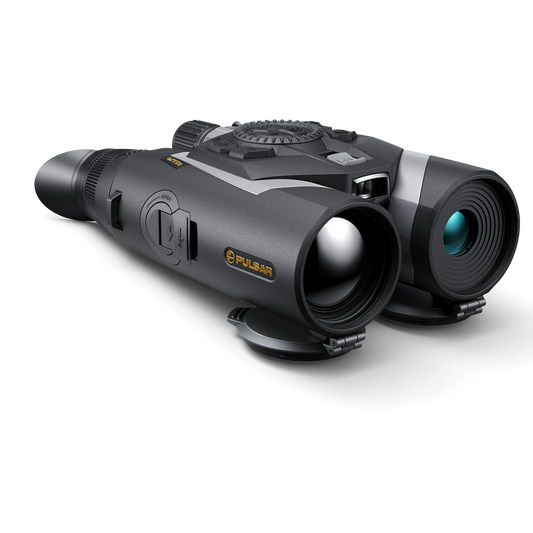

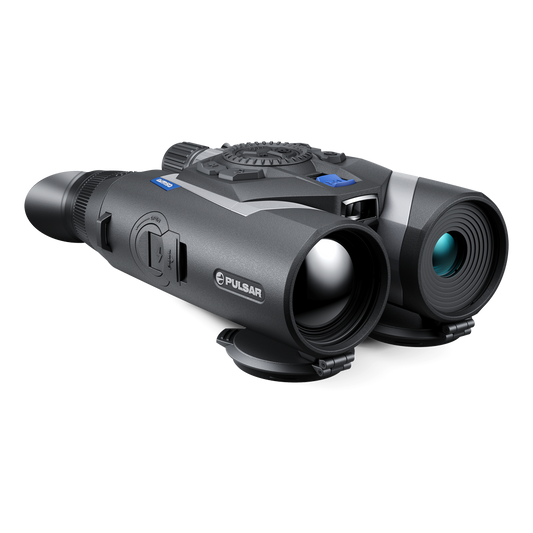
Pulsar Symbion — Multispectral Thermal and Digital Binoculars
The Symbion line answers a problem every thermal user runs into eventually: thermal is unmatched at finding something, and poor at telling you what it is. A Symbion carries two imaging channels in one magnesium housing — a 12 µm thermal sensor for detection and a digital day/night channel for visible detail — so you can sweep a field with thermal, then switch channels to confirm what you are looking at before you act.
New to thermal? Start here:
These are the flagship handhelds in the Pulsar range. Both models detect to 2,515 yards, range with a built-in laser to 1,640 yards, and are built around the removable APS5 battery with 64 GB of onboard storage.
If you want thermal only, see the Merger thermal binoculars or the Telos and Axion monoculars. Our thermal vs. night vision guide explains exactly what the second channel buys you.
Choosing Between the DXT50 and the DXR50
Both share the same 50 mm F1.0 objective, the same body, the same detection range and the same rangefinder. The difference is what the sensor does with the light — and it is not a simple better-or-worse split.
Detail and search area — the DXT50
The DXT50 runs a 1280×1024 @ 12 µm sensor. Because it packs more pixels behind the same lens, it delivers a 17.5° field of view (30.7 m at 100 m) — nearly double the DXR50's. More resolution and more ground at once, which is the combination you want when you are searching rather than studying.
Reach and runtime — the DXR50
The DXR50 runs a 640×480 @ 12 µm sensor with 4–32x magnification against the DXT50's 2–24x thermal, so it pulls distant subjects in harder. It also holds a slightly better NETD rating (<35 mK against <40 mK) and runs 10 hours to the DXT50's 8. Narrower view, longer reach, longer night — and around $2,000 less.
Worth knowing before you buy on range alone. Both models detect a heat source to 2,515 yards, but the laser rangefinder measures to 1,640 yards. You can see a signature considerably further out than you can put a number on it — and detecting something is not the same as identifying it, which is the whole reason the digital channel exists. See how far a thermal optic can really see.
Sensitivity
Resolution decides how much detail a sensor can resolve; NETD decides how much thermal contrast it can separate, and lower is better. The DXR50 rates <35 mK and the DXT50 <40 mK, though the DXT50 also carries an sNETD of <20 mK with Pulsar's signal processing applied. If you glass humid or heat-soaked ground where contrast collapses, this spec matters more than pixel count — our NETD explained guide covers why.
Symbion Model Comparison
| Spec | Symbion LRF DXT50 | Symbion LRF DXR50 |
|---|---|---|
| Thermal sensor | 1280×1024 @ 12 µm | 640×480 @ 12 µm |
| NETD | <40 mK (sNETD <20 mK) | <35 mK |
| Magnification | Thermal 2–24x / Digital 6.5–26x | 4–32x |
| Field of view @ 100 m | 17.5° / 30.7 m | 8.8° / 15.4 m |
| Objective lens | 50 mm / F1.0 | 50 mm / F1.0 |
| Detection range | 2,515 yd (2,300 m) | 2,515 yd (2,300 m) |
| Laser rangefinder | 1,640 yd, ±1 m | 1,640 yd, ±1 m |
| Battery life | 8 hrs | 10 hrs |
| Battery / power | APS5 removable, USB-C PD 5V/9V | APS5 removable, USB-C PD 5V/9V |
| Onboard memory | 64 GB | 64 GB |
| Video / photo | 1920×1080 .mp4 / .jpg | 1920×1080 .mp4 / .jpg |
| Body / rating | Magnesium alloy, IP67 | Magnesium alloy, IP67 |
| Operating range | −13 to 122 °F | −13 to 122 °F |
| Weight | 2.2 lb (35.2 oz) | 2.2 lb (35.2 oz) |
| Mount | 1/4" socket | 1/4" socket |
| View the DXT50 | View the DXR50 |
Where a Multispectral Binocular Earns Its Place
Land management and property monitoring
- Sweep fence lines and fields on thermal, then switch to the digital channel to tell a hog from a heifer before you act.
- Record what you find — 64 GB of onboard storage and 1080p capture make documentation straightforward.
- Mount on a tripod via the 1/4" socket for static watches without arm fatigue.
Research and wildlife observation
- Observe nocturnal behaviour without visible light disturbing it.
- Positive species identification matters here, and thermal alone rarely provides it.
- A 10-hour runtime on the DXR50 covers a full night without a battery swap.
Long observation sessions
- Both eyes engaged means far less fatigue than a monocular over several hours.
- IP67 and a −13 °F floor mean weather is not the thing that ends the session.
- USB-C power delivery lets you run from a power bank when the pack runs down.
Getting the Most From a Symbion
- Search on thermal at low magnification, then zoom and switch channels to identify. Over-zooming thermal costs image quality fast.
- Range before you move, not after — the LRF reads to 1,640 yards.
- Switch palettes as humidity and ground temperature change; contrast is not fixed through a night.
- Keep the objective clean. Smudges cost more effective range than any setting.
- Carry a spare APS5. Runtime figures assume around 71 °F, and cold shortens them.
Frequently Asked Questions
What does multispectral mean on a Symbion?
Each Symbion carries two imaging channels in one housing: a thermal sensor that finds heat, and a digital day/night channel that shows visible detail. You detect with thermal, then switch to identify. Our thermal vs. night vision guide covers the difference between the two technologies.
Which should I choose, the DXT50 or the DXR50?
The DXT50 has the higher-resolution sensor and a field of view nearly twice as wide, so it shows more ground in more detail — better for searching. The DXR50 magnifies harder (4–32x), rates slightly better on NETD, and runs two hours longer, for less money — better for reach and long nights.
How far can a Symbion detect and range?
Both detect a heat source to 2,515 yards. The laser rangefinder measures to 1,640 yards at ±1 m. Detection is not identification, and it is not an ethical shot.
Can I mount one on a tripod?
Yes — both have a 1/4" socket for a standard tripod or window mount.
Are they weatherproof?
Both are magnesium alloy, IP67-rated, and operate from −13 to 122 °F.
Can they be used during the day?
Yes. Thermal reads heat rather than light, and the digital channel is a day/night channel. How thermal imaging works.