

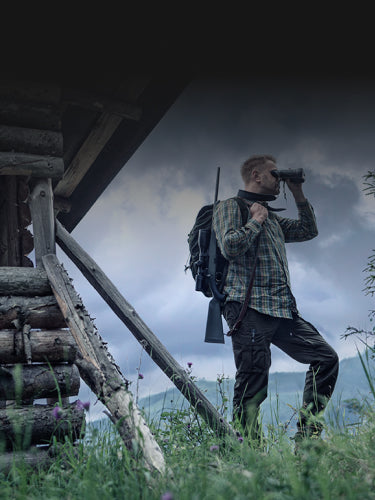

A thermal scope allows users to detect heat rather than rely on reflected or amplified light. That fundamental difference reshapes how optics perform at night, in poor weather, and across difficult terrain. Hunters, tactical professionals, and surveillance operators all benefit from thermal optics, but only when they understand how environmental conditions influence performance.
This article explains how a thermal rifle scope behaves in real-world weather and terrain, with an emphasis on accuracy rather than exaggeration.
How a Thermal Scope Sees the World
A thermal scope such as Pulsar’s Thermion 2 XL60 does not amplify light. Instead, it detects differences in temperature and converts them into a visible image. Warm objects stand out against cooler backgrounds, allowing users to detect animals, people, or vehicles in complete darkness.
Because thermal optics rely on heat contrast rather than illumination, they respond to environmental conditions differently than traditional optics. Some conditions improve performance by increasing temperature separation, while others reduce clarity or detection range by flattening contrast. These effects follow predictable physical principles rather than brand or price point.
Rain
Rain has far less impact on thermal scopes than on daylight optics or night vision. Raindrops scatter visible light, but they do not block infrared radiation in the same way. As a result, a warm target remains detectable through rainfall.
That said, rain still slightly degrades image quality. Falling rain introduces visual noise that softens the image and reduces fine detail. At longer distances, contrast drops and outlines become less defined. Detection usually remains possible, but identification becomes more challenging. Even so, a thermal scope still outperforms night vision in rainy conditions because it does not rely on reflected light.
Fog
Fog has a measurable effect on thermal optics because it consists of suspended water droplets that absorb and scatter infrared energy. As fog density increases, detection range decreases. Light fog may cause only a modest reduction in range, while dense fog can significantly limit how far a thermal scope can detect heat signatures.
Despite this, thermal scopes still perform better than night vision in fog. Night vision systems depend on ambient or artificial light, which fog disperses heavily. Thermal optics lose range in fog, but they retain functionality and remain usable where night vision becomes ineffective.
Humidity
High humidity affects thermal scopes by increasing the amount of infrared absorption in the air. Moist air gradually weakens thermal signals over distance, reducing contrast and compressing usable detection range.
In humid environments, images tend to appear flatter, especially at longer ranges. Targets do not disappear, but the separation between target and background becomes less pronounced. This effect is most noticeable in warm, humid climates where temperature differences are already minimal.

Snow and Ice
Cold environments generally improve thermal performance by increasing the temperature difference between warm targets and cold surroundings. Snow-covered terrain provides a cold background that allows animals and people to stand out clearly.
However, heavy snowfall introduces airborne interference that reduces clarity and adds visual noise. While warm targets remain visible, fine details become harder to resolve at distance. Light snow has little effect, but heavy snowfall shortens effective range and softens the image.
Smoke and Dust
Thermal scopes are capable of seeing through smoke better than visible-light optics because smoke scatters light more than infrared energy. This allows thermal optics to remain usable in conditions where daytime scopes and night vision fail.
Dense smoke or dust clouds still reduce clarity and effective range, especially when particles are thick or heated. While detection often remains possible, identification becomes more difficult as image definition decreases, but in situations like this, thermal is preferable to night vision for the same reason that night vision relies on reflected or amplified light, which smoke and dust scatter aggressively, washing out the image and rapidly collapsing usable range. Thermal optics are not dependent on light at all, so even when particulate matter degrades image sharpness, a warm target still separates from the background in a way night vision cannot replicate.
Using Thermal Optics Effectively Means Understanding Their Limits
A thermal scope is not immune to weather, terrain, or physics. What it offers is reliable detection capability in conditions that defeat traditional optics.
By understanding how environmental factors influence thermal performance, users can make better decisions about distance, timing, and target identification. With realistic expectations and proper technique, a thermal rifle scope remains one of the most capable tools available for low-light and no-light observation.
Frequently Asked Questions
How does a thermal scope differ from night vision?
A thermal scope detects heat differences rather than amplifying visible or infrared light. This allows it to function in complete darkness and in conditions where light-based systems struggle, such as smoke, rain, or heavy shadow.
Do thermal scopes work in the rain?
Yes. Rain has minimal impact on a thermal scope’s ability to detect warm targets. Image clarity may soften slightly due to visual noise, but detection usually remains reliable, especially compared to night vision.
How does fog affect thermal scope performance?
Fog reduces detection range by absorbing and scattering infrared energy. Light fog causes modest range loss, while dense fog can significantly limit how far heat signatures can be detected, though thermal remains usable longer than night vision.
Does high humidity reduce thermal image quality?
High humidity absorbs infrared energy over distance, flattening contrast and reducing effective range. This is most noticeable in warm, humid climates where background and target temperatures are already close.
Are thermal scopes better in cold or snowy environments?
Cold environments generally improve thermal performance because warm targets contrast sharply against cold backgrounds like snow or ice. Heavy snowfall can reduce clarity, but detection remains strong.
Can thermal scopes see through smoke or dust?
Thermal scopes perform better than visible-light optics and night vision in smoke or dust because they do not rely on reflected light. Dense particulate matter can reduce image detail, but warm targets still separate from the background.
